Where to find IT consultants who are available now
Many of the consultants free this week are employed and between projects. Where they are, how they differ from freelancers, and how to reach them.
For agenciesPublished on 8 min read
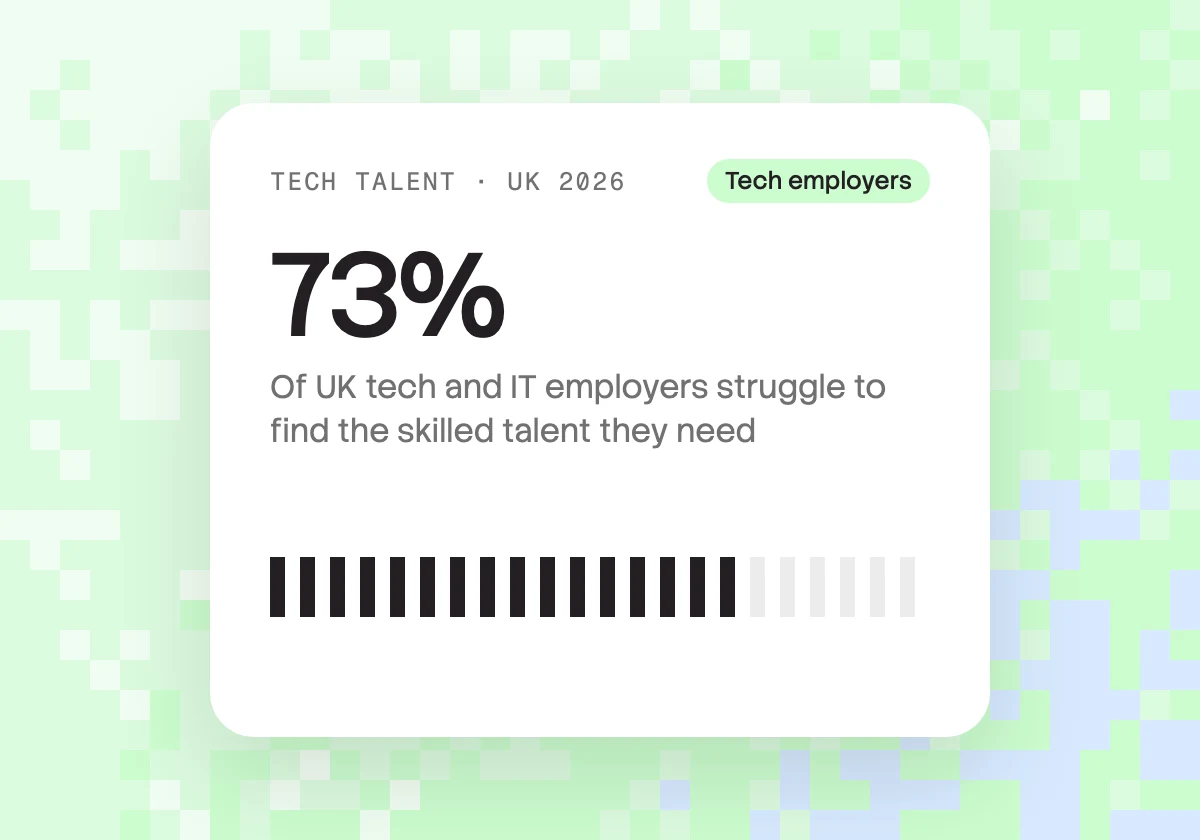
Many of the IT consultants who are available this week are on the benches of IT consultancies: permanent employees between two client projects, who rarely appear on job boards or LinkedIn's "open to work" list because they already have a job. Their employer knows they are free; the market does not. To find them, add consultancies' benches to your usual channels (your own database, referrals, job boards, contractor communities), either through direct relationships with consultancies or through a bench-sharing network. The need is real: 73% of UK tech and IT employers say they struggle to find the skilled talent they need (ManpowerGroup, 2026).
Why do the usual channels show the same candidates?
Job boards, CV databases and LinkedIn do one thing well: they show you people who are looking. Every agency on the same brief uses the same channels, so a strong active candidate gets several calls the day a role goes out, and in contingency recruitment, second place earns nothing.
There is no shortage of people looking. UK recruiters reported candidate availability still rising in September 2026, while IT & Computing led the rise in demand for permanent staff and was one of only three sectors where temporary vacancies grew (KPMG and REC, Report on Jobs, October 2026). At the same time, 73% of UK tech and IT employers say they struggle to find the skilled talent they need, down from 75% in 2025 (ManpowerGroup 2026 Talent Shortage Survey, reported in the Experis Tech Talent Outlook, June 2026).
More people are looking, but not more of the specific people a client asks for: the senior consultant with the exact stack and the start date. That person is often not looking at all.
What is a bench consultant, and why aren't they on job boards?
A bench consultant is a permanent employee of an IT consultancy who is between two client projects. They are paid in full and billing nobody: that unbilled time is called bench time. Projects end on the client's timetable, not the firm's, so every consultancy has some.
They are not on job boards because they are not looking for a job. They have one. What they need is their next project, and their employer wants it as much as they do, because every bench day is salary with no invoice behind it.
Consultancies also rarely advertise their bench, which can read as weakness to clients, so the information stays in a resource plan or a message group with a few peer firms. For a recruiter, this is the best kind of candidate: available now, tested on client work, and employed by a firm that wants to say yes.
Bench consultant or freelancer: what does your client get?
Both are good answers to a contract role, and freelancers are the right fit for many of them. The difference is who you deal with: a freelancer is an individual business; a bench consultant comes with the company that employs them.
| Bench consultant | Freelancer | |
|---|---|---|
| Employment | Permanent employee of an IT consultancy, paid between projects | Self-employed, usually through their own limited company or an umbrella company |
| Who stands behind the work | The employer, which knows their work on past client projects | The contractor, with their own references |
| How fresh the availability is | Known to the employer day by day; the firm must agree to release them | Depends on when their current contract ends and on the other offers they hold |
| Who you contract with | The consultancy, as your supplier, company to company | The contractor's company or their umbrella company |
| IR35 | The off-payroll rules target workers who supply their services through their own intermediary, usually a company they control (HMRC); a consultant employed by a consultancy is generally outside them. This is not tax advice | Each role needs a status assessment |
| If it doesn't work out | You can ask the same firm for a replacement; agree it in your contract | You start the search again |
Where can you find IT consultants who are available now?
Use several together. Each reaches a different part of the market.
| Channel | Good for | What it costs you | How fresh the availability is |
|---|---|---|---|
| Your own database | People you have worked with or met before | Your time | Ages quickly: call before you submit |
| Referrals from contractors and clients | Trusted fit, warm introduction | Time, sometimes a referral fee | Current, but occasional |
| Job boards and CV databases | Volume of active candidates | Posting or subscription fees | Active, and shared with every other agency |
| LinkedIn search and "open to work" | Reach, checking a profile | A recruiter seat for serious search | Self-declared, updated when the person remembers |
| Contractor communities and meetups | Niche skills, freelancers | Time and presence | Good for freelancers, rarely for employed staff |
| Direct relationships with consultancies | Employed consultants, with the employer's word | Time to build, one firm at a time | Current when you call; limited to the firms you know |
| A bench-sharing network such as BenchBee | Many consultancies' benches through one job post | Free to post; you pay per accepted match (pricing) | Listed by the employer as available |
The first five mostly reach people who are looking. The last two reach people who are employed and free.
How do you check that "available" really means available?
An available consultant is only useful if they can start when your client needs them. Before you put anyone forward, ask the consultancy five questions:
- Has the current project ended, and if not, when does it end? "Available from the 1st" and "available now" are different answers for your client.
- Will the firm release them for the full length of the contract? A consultancy may need the same person for its own project next quarter. Ask now, not in week six.
- Can they interview this week? It is the quickest test of real availability.
- Is the day rate set for this role? Location, on-site days and IR35 status can all change it.
- Has the consultant agreed to be put forward? An employed consultant should know about, and want, the role before your client sees their profile.
How can you source pre-vetted IT talent more efficiently?
"Pre-vetted" is used loosely, so it helps to say what it covers. In practice, three different checks hide behind the word:
- The company is real. It is registered, trading and does what it says.
- Someone stands behind the consultant. An employer that has seen their work on client projects, and puts its name to the proposal.
- The consultant fits this role. Skills, experience and the client's culture, which only an interview, references and sometimes a technical test can tell.
The third check stays yours, whatever the source. The efficiency comes from the first two: sourcing from employers means one conversation can cover several consultants, already filtered by the firm that hired them.
That is the line BenchBee draws. Every consultancy is checked against Companies House in the UK, or the local registry elsewhere, and goes through an onboarding call before it joins. BenchBee does not test individual consultants: the employer stands behind its consultant, and the fit for your client stays your judgement. More on this in a coming article, How to source pre-vetted IT talent.
How do you reach consultancies' benches without cold-calling?
Calling consultancies one by one works, but it only reaches the firms you already know. A bench-sharing network turns it around: you post the role, and the consultancies with someone who fits come to you.
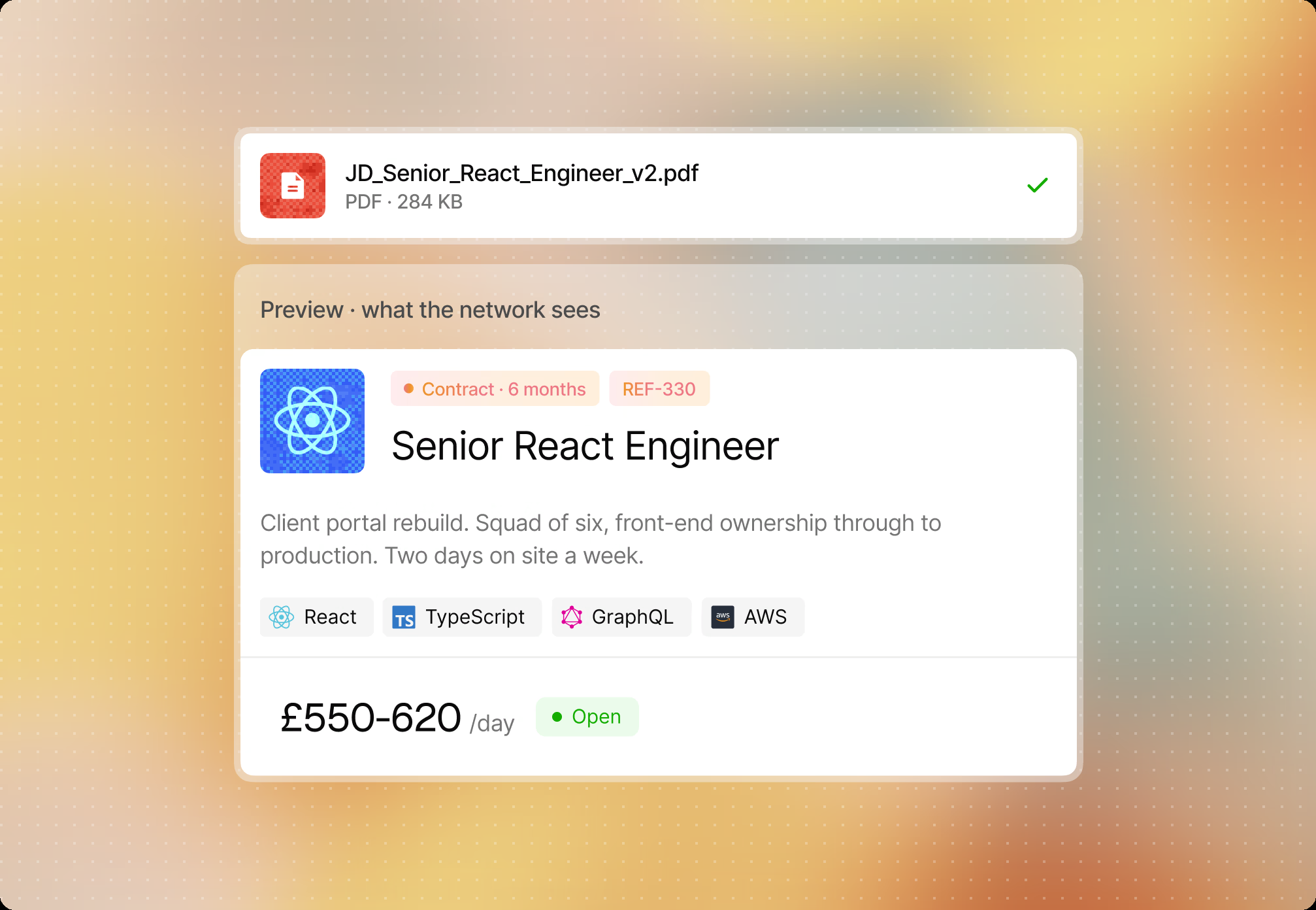
On BenchBee, verified IT consultancies in the UK, Europe and the GCC list their available consultants, and IT recruitment agencies post the jobs they are hired to fill:
- Post the role. Posting is free and unlimited. Your agency name stays hidden, and your end client is never named on BenchBee.
- Matching consultancies come to you. A consultancy with an available consultant who fits sends a match request. You don't search, and nobody can cold-call you. The request tells you which consultancy is asking.
- Accept and get introduced. Accepting reveals both sides and opens a chat on BenchBee, with the history kept for both firms. You arrange the interviews and agree the rate and the contract directly with the consultancy, on your own paper.
BenchBee takes no commission and is not a party to the contract: your fee stays yours. Your first 3 accepted matches are free; after that you pay per accepted match (pricing). The step-by-step guide, including what a consultancy sees and when, is in How to share a role without naming your client. On speed: How to fill an IT contract role faster. The whole network is explained in How it works, and the agency side on BenchBee for agencies.
Sources: ManpowerGroup, 2026 Talent Shortage Survey, as reported in the Experis Tech Talent Outlook Q3 2026 (UK), June 2026. KPMG and REC, UK Report on Jobs, 10 October 2026. HMRC, "Understanding off-payroll working (IR35)", updated 26 February 2026.