What bench time really costs an IT consultancy
A worked example for one consultant, the costs payroll does not show, and how to work out your own.
For consultanciesPublished on 6 min read
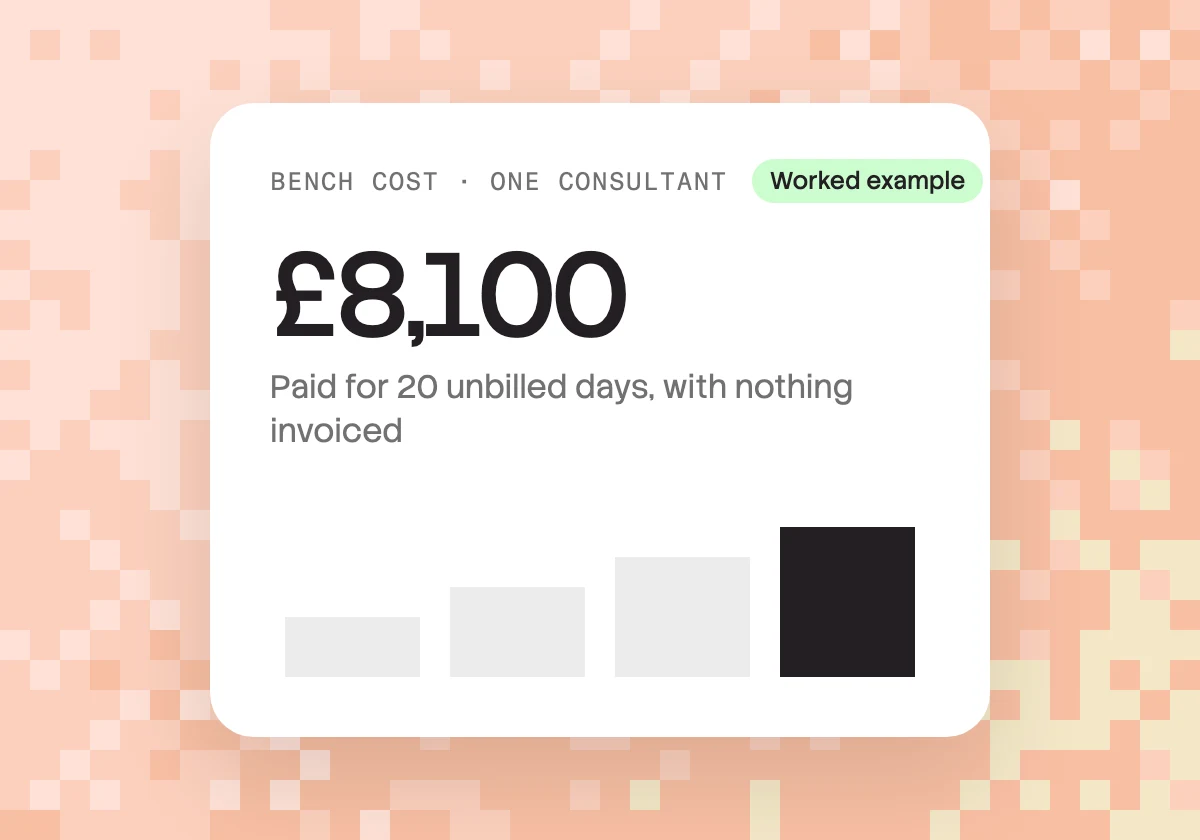
A benched consultant costs their full loaded employment cost for every working day they are not billed, and the firm loses the invoice it would have sent. In our worked example, a consultant on a £65,000 salary costs the firm about £406 per available working day, so 20 days on the bench means about £8,100 paid with nothing invoiced, and £13,000 of billing that never happens. Across professional services firms, IT consultancies among them, billable utilisation was 68.9% in 2024 and fell to 66.4% in 2025, the lowest SPI Research has recorded, against the 75% SPI considers optimal. Most of that gap is the bench.
What does one consultant on the bench cost?
Bench time is paid time with no client to bill. To see what it costs, start with what the consultant costs the firm in a year, not their salary alone.
Worked example, illustrative:
| Line | A year |
|---|---|
| Salary | £65,000 |
| Employer National Insurance (15% above £5,000, 2026/27 rates) | £9,000 |
| Employer pension contribution (5%) | £3,250 |
| Benefits, equipment, office space and a share of management time (our assumption) | £12,000 |
| Loaded cost | £89,250 |
| Available working days (260 weekdays, less 25 days' holiday, 8 bank holidays and 7 days of training and sickness) | 220 |
| Loaded cost per available day | about £406 |
| Day rate billed to the client | £650 |
| Profit per billed day | about £244 |
Now put that consultant on the bench for 20 working days, about one month:
- Paid: about £8,100 in salary and employment costs.
- Invoiced: nothing.
- Billing that did not happen: £13,000.
- Profit lost: about £4,900.
The line that matters most: one bench day costs £406, and it cancels the profit of about 1.7 billed days. A consultant who is billed three days and benched two is barely covering their cost.

How do you calculate your own bench cost per month?
Three steps, with numbers you already have in payroll and timesheets.
- Work out the loaded cost per available day for each consultant. Add salary, employer National Insurance, pension, benefits and a fair share of overhead, then divide by the days they can actually work in a year (about 220 for a full-time UK employee).
- Count the unbilled working days in the month. Use timesheets or the resource plan. Count partial bench too: a consultant billed three days a week has two bench days a week.
- Multiply and add up. Loaded cost per day times unbilled days, for every consultant. Then do the same with each consultant's day rate to see the billing that did not happen.
What to include in loaded cost:
- Salary and any guaranteed bonus
- Employer National Insurance and pension
- Benefits: health cover, car allowance, training budget
- Equipment and software licences
- A share of office, finance and management costs
Most firms that run this for the first time find the number is higher than they guessed, because the bench rarely shows up as one line. It is spread across many consultants, a few days each.
What costs don't show up in the payroll line?
The payroll cost is the visible part. Three costs sit behind it.
The invoice that never went out. The salary is paid either way. What bench time really takes is the billing: in the example, £13,000 a month for one consultant, of which about £4,900 would have been profit.
The consultant who leaves. Good consultants do not like sitting idle, and a long bench is a common reason to start looking. Replacing a worker earning £25,000 or more cost a UK employer £30,614 on average, and a new hire from another sector took 32 weeks to reach full productivity, against 15 weeks from the same sector (Oxford Economics and Unum, 2014). The figures are old, and salaries have risen since, so treat them as a floor.
The bid taken at the wrong rate. A full bench puts pressure on sales to win anything, and the quickest way to win is a lower day rate. A discount on a twelve-month engagement can cost more than the bench it was meant to fill.
What does the industry's utilisation gap say about the bench?
Billable utilisation is the share of a consultant's available time that is billed. Across professional services firms, it averaged 68.9% in 2024 (SPI Research, 403 firms) and fell to 66.4% in 2025, the lowest SPI has recorded (over 500 firms). SPI considers 75% optimal: utilisation between 70 and 80% has historically maximised profitability, and firms above 80% suffer more burnout and attrition.
What that gap is worth, with the same worked example:
| Utilisation | Billed days a year | Profit from one consultant |
|---|---|---|
| 69% (industry, 2024) | about 152 | about £9,400 |
| 75% (SPI's optimum) | 165 | about £18,000 |
| 80% | 176 | about £25,150 |
For a 50-person consultancy, each point of utilisation is 110 more billed days, or £71,500 of billing a year. Almost all of it is profit, because the salaries are already paid. Going from 69% to 75% is worth about £429,000 a year.

What happens when consultants aren't billable for months?
The cost adds up in a straight line. Three months on the bench is about 60 working days: about £24,300 paid and £39,000 not billed. In the example, that wipes out more than two and a half years of the profit the consultant makes at 69% utilisation.
Firms respond in four usual ways, each with its own cost:
- Training and internal projects. The consultant's skills stay current, but the time is still unbilled.
- Work at a lower rate. Covers part of the cost, and can set a price the client remembers.
- Lending the consultant to another firm for the gap. The consultant stays on payroll and is billed at an agreed rate to a consultancy or agency that needs the skill.
- Letting the consultant go. Removes the cost, then costs a hire when the next project lands.
Large firms now set hard limits. TCS, for example, requires its staff to be billed for at least 225 business days a year, which leaves 35 days on the bench at most (Outlook Business, June 2025, from an internal TCS policy). Smaller firms rarely write a rule down, but they live with the same arithmetic.
Where to go from here
There are three ways to cut the cost of the bench: see the gap coming earlier, fill it with useful internal work, or fill it with billed work from outside the firm. Each is covered in How to reduce consultant bench time costs. Why the gaps happen in the first place: Why IT consultants sit idle between projects.
The third route is the one most firms do informally, through the four or five consultancies they know. BenchBee is a private network built for it: verified IT consultancies in the UK, Europe and the GCC list their benched consultants, and peer consultancies and IT recruitment agencies post the roles they need to fill. Companies stay hidden until they choose to reveal themselves, the two firms agree the rate and the contract directly, and BenchBee takes no commission. How it works · Pricing for consultancies.
Sources: SPI Research, Professional Services Maturity Benchmark 2025 (2024 data, 403 firms) and 2026 (2025 data, over 500 firms, reported by Deltek, 30 July 2026); SPI Research, "The truth about billable utilization", 18 March 2025. Oxford Economics and Unum, "The Cost of Brain Drain", 2014. HMRC, rates and thresholds for employers 2026 to 2027. Outlook Business, 17 June 2025. The salary, day rate and overhead figures are an illustrative example, not a benchmark.