Why IT consultants sit idle between projects
The five causes of bench time, why even well-run firms carry it, and what AI changes.
The bench economyPublished on 7 min read
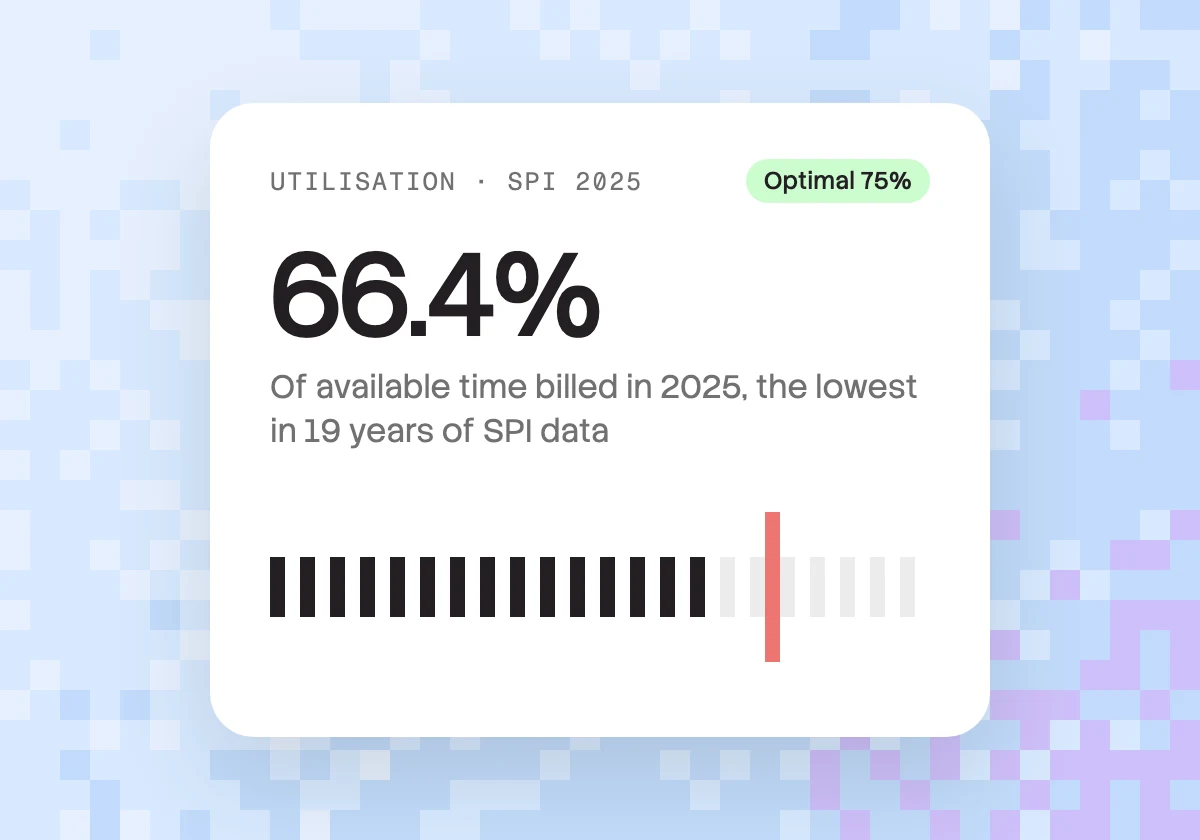
IT consultants sit idle between projects because client work arrives in waves while permanent headcount grows in a straight line. So a consultancy is overstaffed on one skill and short on another, often in the same month, and the people in the trough sit on the bench: paid, available, billed to no one. Five causes explain most of it: project gaps, skills mismatch, sales lag, over-hiring for one account, and client-side delays. The gap is widening: professional services firms billed 66.4% of their available time in 2025, the lowest in 19 years of SPI Research benchmarks, down from 68.9% in 2024 and below the 75% SPI treats as optimal.
Projects come in waves. Headcount doesn't.
A consultancy sells projects, and projects end. Its main cost is people, hired one at a time and kept. Demand moves in waves: a large programme lands, two smaller ones end, a client freezes spending. Headcount moves one way, mostly up, in steps.
Put the two lines on one chart and the bench appears on its own. Where work rises above headcount, the firm is understaffed: it turns work away or hires. Where work falls below it, the firm is overstaffed, and the people under the line are on the bench. Hire for a peak, and the new people often arrive as the work dips.

The waves differ by skill. The data team can be turning work away while two Java developers wait for a brief: short-staffed and paying for a bench in the same month.
Five reasons consultants end up on the bench
1. Project gaps
A project ends on a date the client set months ago. The next one starts when the next client signs, rarely the day after. Even a firm with a full pipeline loses days or weeks at each hand-over. When several projects end in the same month, at the end of a client's financial year for example, several people land on the bench at once.
2. Skills mismatch
The pipeline asks for Kubernetes; the available consultant knows Oracle. The firm has people and work, just not matching ones. Training closes the gap for neighbouring skills, but it takes weeks, and it does not turn a database specialist into a cloud architect for a Monday start.
3. Sales lag
When everyone is billed, the people who sell, often the senior consultants who deliver, are busy delivering. Selling slows, the pipeline thins, and the bench shows up a few months later. Then everyone sells, the work arrives in a wave, and the cycle starts again. Some bench is also chosen: a firm keeps a strong consultant free so it can name them in a bid it expects to win.
4. Over-hiring for one large account
A large client asks for a team of twelve, and the firm hires to deliver it. When the client cuts the programme, brings the work in-house or changes supplier, the twelve come back at once. The more headcount tied to one account, the bigger the bench when it changes.
5. Client-side delays
The contract is signed, the consultant is assigned, and the project does not start. Security clearance, procurement, system access, a sponsor who has left: each pushes the start back while the consultant waits, unbilled. This bench is the hardest to see, because on the resource plan the consultant looks allocated.
Which cause is yours? Your timesheets and resource plan usually tell you which one dominates:
| What you see | Likely cause |
|---|---|
| The bench rises in the weeks after projects end, then clears | Project gaps |
| People on the bench and roles you can't staff, at the same time | Skills mismatch |
| The bench rises a few months after your busiest quarter | Sales lag |
| Several consultants from one account on the bench together | Over-hiring for one account |
| Consultants allocated on the plan but not yet billing | Client-side delays |
What to do about each one is in How to reduce consultant bench time costs.
How is AI changing team size and the bench?
In McKinsey's study, developers using generative AI completed some coding tasks up to twice as fast: documentation in half the time, new code in nearly half the time (McKinsey, June 2023). The gains are uneven: time savings shrank to less than 10% on tasks the developers rated complex, and junior developers sometimes took 7 to 10% longer. A 2025 trial with 16 experienced open-source developers found they took 19% longer on real tasks when AI was allowed, while believing it had made them faster (METR, July 2025).
Our reading: where the speed-up is real, the same project needs fewer people, or the same people for fewer weeks, and clients will ask for smaller teams. For a consultancy sized for yesterday's teams, that means more people between projects, more often. AI also shifts the skills clients ask for faster than most firms retrain, which feeds cause 2.
No study yet measures AI's effect on bench time directly; a precise number today is a guess.
Is the bench a sign of bad management?
No. The bench is the shape of the business, not a failure of it. A firm that sells projects and employs the people who deliver them will always have some of them between projects. Billable utilisation across professional services fell to 66.4% of available time, the lowest SPI Research has recorded in 19 years of benchmarks. That is a whole industry, well-run firms included.

A firm with no bench at all is usually turning work away, or running its consultants above 85% utilisation, where training, selling and rest stop. What does signal a problem is a bench nobody sees until the month-end report, or the same cause coming back quarter after quarter.
How long is too long on the bench?
There is no published industry average. What exists are firm policies. Since 12 June 2025, TCS requires its staff to be billed for at least 225 business days a year, which leaves 35 business days on the bench at most. The policy document warns that long periods without an assignment affect pay, career growth and continuity of employment (Outlook Business, 17 June 2025, from an internal TCS document first reported by the Times of India).
For a smaller firm, a practical reading:
- Days: a normal hand-over. Use them for training, bids and internal work.
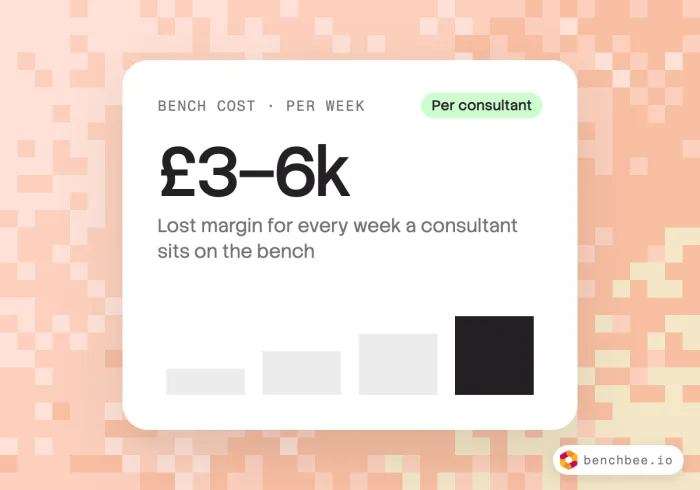
- Weeks: a cost worth acting on: each one is a week of salary with nothing invoiced (What bench time really costs an IT consultancy).
- Months: a risk to the consultant as well as the margin. Good consultants do not like sitting idle, and a long bench is a common reason to start looking elsewhere.
The talent exists. Nobody can see it.
The consultant on one firm's bench is very often the profile another consultancy, or a recruitment agency's client, is looking for that same month: their waves are out of step. But an employed consultant between projects never appears on a job board, so the two rarely meet, except through the four or five firms each founder knows.
Talent sharing closes that gap: lend a benched consultant for the gap, borrow one for a peak, and each consultant stays employed by their own firm. Why and how: Why IT consultancies share talent with each other.
BenchBee is a private network built for it. Verified IT consultancies in the UK, Europe and the GCC list their consultants between projects, by skills, seniority and availability, with no consultant or firm name, and post the roles they can't staff. IT recruitment agencies post the jobs their clients need filled. Companies stay hidden until they choose to reveal themselves: sending a match request reveals the sender, and accepting reveals both. The two firms then agree the rate and the contract directly, and BenchBee takes no commission. How it works · BenchBee for consultancies · Pricing for consultancies.
Sources: SPI Research, Professional Services Maturity Benchmark, 2025 edition (403 firms, published 12 February 2025) and 2026 edition (509 firms, published 24 February 2026). McKinsey, "Unleashing developer productivity with generative AI", 27 June 2023. METR, 10 July 2025. Outlook Business, 17 June 2025. The FAQ salary figure is an illustrative example.