How to reduce consultant bench time costs
Seven levers, ranked by how many bench days they turn into billed days, with what each one costs and where it stops working.
For consultanciesPublished on 7 min read
You reduce bench time costs in only two ways: fewer days go unbilled, or the unbilled days earn something. The levers that do most are seeing the gap early (a forecast tied to the sales pipeline), filling it inside the firm, and billing it outside the firm by lending the consultant to a peer consultancy or an agency's client for the length of the gap. Training, pre-sales and internal projects keep a consultant useful, but the day stays unbilled. The pressure is growing: across 509 professional services firms, billable utilisation fell to 66.4% in 2025, the lowest SPI Research has recorded, against the 75% it considers optimal.
Why are bench costs so hard to cut?
Projects come in waves. Headcount grows in a straight line. Every IT consultancy lives in the gap: overstaffed on one skill when a project ends, short on another when a deal lands.

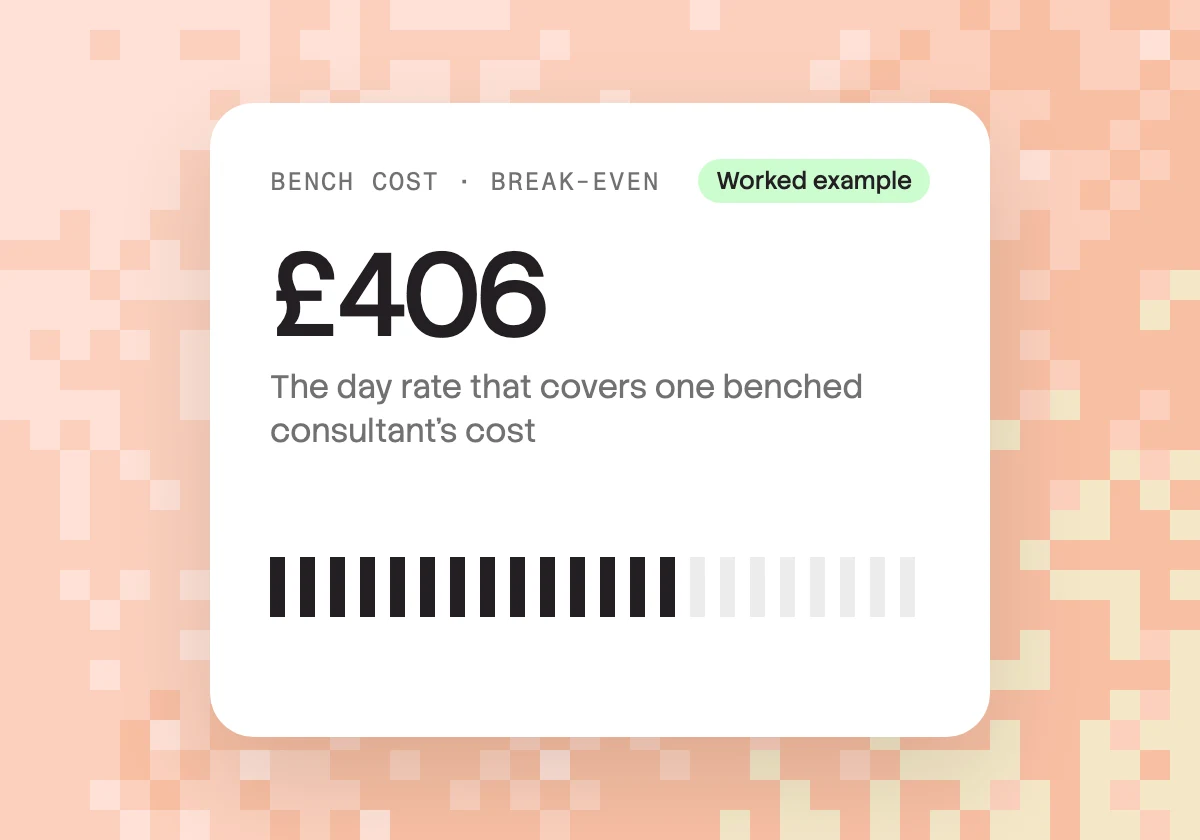
Each day in that gap is paid. In our worked example, a consultant on a £65,000 salary costs about £406 a working day, so one bench day cancels the profit of about 1.7 days billed at £650. The full calculation is in What bench time really costs an IT consultancy.
The obvious cut, fewer people, rarely saves money: staff for the trough and the next peak finds nobody to deliver it. Replacing a UK worker earning £25,000 or more cost £30,614 on average (Oxford Economics and Unum, 2014; treat it as a floor). The levers below work on the days, not the headcount. Why gaps open: Why IT consultants sit idle between projects.
Seven ways to reduce bench time costs
Ranked by how many bench days each one turns into billed days. The first two stop gaps opening, the next three bill them, the sixth prevents the next bench, and the last bills nothing.
1. Forecast the gap from the pipeline
- What it does: puts every consultant's end date next to the deals likely to close, eight to twelve weeks ahead, so a gap can be sold before it opens.
- What it costs: an hour a week with sales and delivery together, and one shared list of skills and availability.
- Its limit: it shows the gap, it does not fill it, and it is only as honest as the pipeline. A deal that slips six weeks is six weeks of bench.
2. Negotiate extensions and stagger end dates
- What it does: raises the next phase two months before the end, not two weeks, and avoids several engagements ending in the same fortnight.
- What it costs: account management time.
- Its limit: the client decides, and an extension asked for late tends to come at a lower rate.
3. Split consultants across engagements
- What it does: bills a consultant three days a week on one client and two on another, instead of five, then nothing.
- What it costs: coordination for the delivery manager.
- Its limit: many clients want people full time, and part billing only cuts the loss. In the worked example, three days at £650 bring in £1,950 a week against about £2,030 of cost.
4. Move people across accounts and practices
- What it does: sends the data engineer finishing a retail project to another practice's new banking client.
- What it costs: a skills view every seller can see, and managers who release people.
- Its limit: it needs demand elsewhere in the firm, and skills that transfer. A senior .NET developer is not a Power BI developer by Monday.
5. Lend benched consultants to other firms
- What it does: the consultant stays on your payroll and works for a peer consultancy, or on an agency's client role, for the length of the gap. Your firm invoices the other firm at an agreed day rate.
- What it costs: usually a lower rate than your own client pays, since the other firm keeps a margin, and a contract between the two firms.
- Its limit: you can only lend to firms you can reach, often the four or five founders you know, and the consultant is away if your own project lands, so agree a notice period first.
The only lever that bills the gap when the firm has no work for that skill. More in Why IT consultancies share talent with each other.
6. Borrow for peaks instead of hiring for them
- What it does: takes a consultant from another firm's bench for a six-month need, instead of hiring permanently.
- What it costs: a day rate that includes the other firm's margin.
- Its limit: skills you sell every quarter belong on your payroll. But every permanent hire made for a peak is a future bench.
7. Put bench days to work inside the firm
- What it does: pre-sales and bids, training in the skills the pipeline is asking for, internal tools.
- What it costs: the whole day, about £406 in the example, with nothing invoiced.
- Its limit: useful, not billed. Keep it for short gaps or for skills the forecast shows coming.
How do you improve resource utilisation across the firm?
Utilisation is billed hours over available hours. Four habits raise it:
- Measure it every week, per person, looking twelve weeks ahead rather than at last month.
- Set targets by role, not one number. SPI Research puts the optimal level around 75%, expects juniors to run higher than seniors, and finds firms above 80% suffer more burnout and attrition (SPI Research, March 2025).
- Give sales the same view as delivery, so deals are shaped around who is free.
- Name an owner for each benched consultant's next assignment, and review it weekly.
It pays. In SPI Research's 2026 benchmark, firms at the top of its maturity model billed 42% more of their time than firms at level 2 (SPI Research, 2026).
Which levers should you start with?
By length of gap:
| The gap | Start with |
|---|---|
| Seen two months or more ahead | Forecast, extension, internal move (levers 1, 2, 4) |
| A few days to two weeks | Split allocation, pre-sales, targeted training (3, 7) |
| Three weeks to months, no work inside | Lend to another firm (5) |
| The same skill short every few months | Borrow rather than hire (6) |
By size: under 50 people, with no resource manager, start with a weekly one-page bench list (1) and make the lending you already do with friendly firms a habit (5). From 50 to 200, a shared skills view (1, 4) and split allocation (3) come first.
What changes when the bench earns?
Run the numbers on one gap. A consultant on a £65,000 salary has 20 working days between projects. On the bench or on internal work, the firm pays about £8,100 and invoices nothing. Lent to another firm at £500 a day, an illustrative rate below the £650 its own client pays, the same days invoice £10,000: the cost is covered, with about £1,900 over. Any rate above about £406 covers the cost; a lower one still cuts the loss.

Most firms lend informally today. BenchBee is a private network built for it: verified IT consultancies in the UK, Europe and the GCC list their benched consultants (profile only: skills, seniority, availability, no consultant or firm name), and peer consultancies and IT recruitment agencies post the roles they need filled. Companies stay hidden until they choose to reveal themselves: sending a match request reveals the sender, accepting reveals both. The two firms agree the rate and the contract directly; BenchBee takes no commission and is not a party to it. Step by step: How to list your benched consultants on BenchBee. How it works · BenchBee for consultancies · Pricing for consultancies.
Sources: SPI Research, 2026 Professional Services Maturity Benchmark, 509 firms (published February 2026; utilisation figures as published by Deltek, the report's sponsor, 30 July 2026). SPI Research, "The Truth About Billable Utilization", 18 March 2025. Oxford Economics and Unum, "The Cost of Brain Drain", 2014. GOV.UK, "Making staff redundant" (checked October 2026). The salary, day rates and lent rate are an illustrative example, not a benchmark.